
Most teams never get past the demo
A prompt can prove the concept. Agentic transformation changes how the work gets done. When agents take on complex operations end to end, workflows like underwriting, claims and research can be reimagined, not just accelerated. But that only happens when the system is designed to operate reliably at scale.
The agent operating system.
Four layers turn agentic AI from experiments into systems built to run the business.
Intelligence
Gives agents expert context.
Experience
Shapes the right way to work.
Orchestration
Coordinates agents and workflows.
Agent Runtime
Runs, evaluates and governs in production.
Intelligence Layer
AlphaAgent automatically turns knowledge documents, policies, research, models and procedures into Intelligence Libraries, reusable bodies of specialist expertise that agents can reason through when they work.
Powered by Augmented Multi-Resolution Property Graphs, AlphaAgent gives agents the right knowledge, in the right shape, at the right moment.
The core idea
Each one is capable, sharp and a fast learner. There are two ways to put them to work, and only one of them scales. The same choice decides whether agentic transformation stalls or compounds.
Take every person into a separate room, teach them a single job.
Every use case starts over.
This is prompt-by-prompt agent building. The expertise stays trapped inside each prompt.
Stand up one Intelligence Library, then trust capable minds to learn from it on the fly, whatever task you set.
Expertise compounds.
This is how AlphaAgent works, and its proprietary engine builds that Intelligence Library for you. A fully managed intelligence layer: almost no effort to stand up, expertise you reuse forever.
The core value
A new use case becomes a new task,
not another six-month build.
Specialist knowledge no longer has to be encoded into every prompt, every agent and every workflow step. Build the Intelligence Library once, and every agent reuses the expertise.
You do not teach every agent every job.
You give capable agents an Intelligence Library to learn from.
When an agent takes on a role — FX trader, volatility analyst, KYC investigator or fraud reviewer — AlphaAgent brings the relevant Intelligence Libraries, concepts and source evidence into focus. The prompt sets the task. The Intelligence Library supplies the expertise.
Intelligence
Libraries
Commodity Volatility Library
For agents working with mean reversion, term structure, inventory, seasonality and supply shocks.
Inside the Intelligence Layer
Anyone can write a prompt. Almost no one can build the knowledge system behind it. That gap is the difference between an agent that sounds like an expert and one that performs like an expert.
The analogy is simple, the engineering is not. A pile of documents in a vector store is not a library, and basic vector or graph RAG barely scratches it. Turning raw knowledge into expertise an agent can use takes three distinct tiers. Each one is hard, the last two especially, and AlphaAgent runs all three.
The librarian in motion
Embedding, indexing and retrieval combine into a single outcome: an agent handed exactly the right knowledge, grounded and traceable, the moment it needs it.
On every request
Find
The agent identifies the Intelligence Libraries and knowledge areas most relevant to the task.
Focus
The system prioritises the concepts, relationships and evidence that matter most.
Reason
The agent follows the right knowledge paths without letting the search spiral.
Storing documents is the easy part.
The librarian is the breakthrough.
AlphaAgent’s Augmented Multi-Resolution Property Graphs are that librarian: they index concepts, relationships and overlaps the way a specialist would, and AlphaAgent builds and runs all three tiers for you, so hard-won expertise becomes something every agent can reuse.
Fully managed creation
Drop in policies, procedures, research packs, model documentation or regulatory guidance, and AlphaAgent’s proprietary engine does the rest. It transforms them into structured, contextual and traceable Intelligence Libraries automatically, so your team carries almost none of the effort.
This is a fully managed intelligence layer. The hard part of the second approach, standing up the Intelligence Library, is handled for you.
AlphaAgent includes built-in Python runtimes and supports Linux-based Docker images, so teams can bring custom libraries, packages and specialist execution environments.
Intelligence Library ecosystem
A Prometheus-built capital markets Intelligence Library, a customer policy Intelligence Library and a partner workflow can all become part of the same agentic system. The Intelligence Layer makes expertise reusable. The Orchestration Layer decides how agents and workflows use it.
Use cases
Prompts instruct.
Intelligence Libraries enable expertise.
This is how AlphaAgent moves agents from generic assistants to domain-capable workers, grounded in reusable specialist expertise, relationships and evidence that can scale across roles, workflows and use cases.
Next layer
Intelligence gives agents specialist understanding. Next, see how people actually work with that intelligence.
Continue to Experience →Experience Layer
The Experience layer decides how agentic capability reaches people, through chat, workflows, APIs, embedded surfaces and managed applications.
Intelligence gives the agent its specialist mind. Experience decides how that intelligence is exposed to every user, team and system, so each one gets the right way to work.
One system, many surfaces
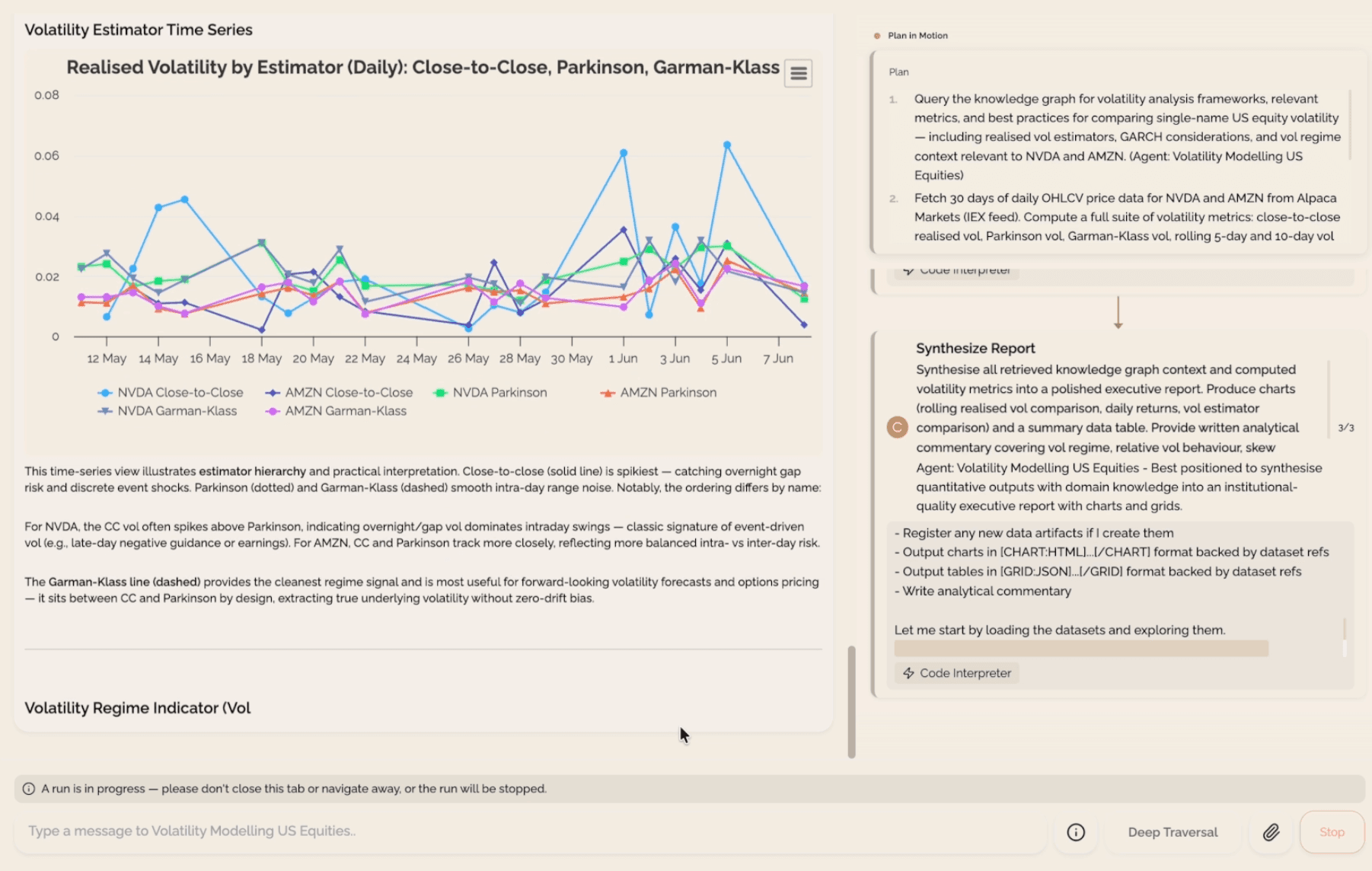
The same agentic capability can appear as a conversation, a workflow, an API or a purpose-built application. The underlying system stays the same. The experience changes to fit the user.
Conversational workspace
Open-ended exploration with sources, charts and outputs alongside the conversation.
The capability does not change.
The way you work with it does.
A trader wants a research workspace. An analyst wants a case review screen. A developer wants an API. AlphaAgent does not force every use case into one interface.
Experience modes
Every interaction model lives under one of three product surfaces: from an open workspace, to your own systems, to a managed application built around a single use case.
AlphaAgent Studio
AvailableThe environment teams explore and operationalise in. Chat for open-ended research and reasoning. Workflows for repeatable, governed, multi-step work, triggered on demand or by events.
Embedded into your systems
AvailableExpose agents through APIs and embedded surfaces so intelligence appears where work already happens, inside operational systems, customer journeys and internal tooling.
Managed Generative Apps
Coming soonPackage agentic capability into a managed, no-code application designed around one workflow, so a business team gets a product, not a prompt.
Why it matters
Capability only creates value when people actually reach for it. Matching the experience to the role, the process and the systems already in place is what moves an agent from impressive demo to everyday tool.
A trader, an analyst and a manager each get a surface built for their job, not a shared blank prompt.
Regulated work carries approvals, evidence and audit trails wherever the agent runs.
Agents live inside the systems teams already use, reached through APIs and embedded surfaces.
Agents don’t live in one chat box.
The interface should fit the work.
This is how AlphaAgent turns agentic capability into usable work, giving every user, team and system the right way to work with the same underlying intelligence.
Next layer
Experience gives every user the right way to work. Next, see how AlphaAgent coordinates specialist agents into teams.
Continue to Orchestration →Orchestration Layer
AlphaAgent coordinates agents like a team, anywhere from dynamic real-time swarms to fully governed workflows, routing each task to the right agents, tools and knowledge paths.
Intelligence gives agents specialist knowledge. Experience gives people the right way to work with them. Orchestration decides which agents act, when, and how work moves from intent to outcome.
One request, the right team
A KYC case may need identity, document, fraud, policy and escalation agents. A research task may need macro, volatility, news, backtesting and risk agents. AlphaAgent coordinates that work from intent to outcome.
Orchestration selects the team
One task.
A coordinated team of agents.
AlphaAgent reads the intent, assembles the right specialist agents, coordinates their work and brings it back as a single, grounded result, not five disconnected answers.
Levels of determinism
Every use case sits somewhere on a spectrum of determinism: how much the agents decide in the moment, and how much is fixed in advance. It governs both how each agent performs its steps and how the whole team works together. AlphaAgent runs the full spectrum, so you match it to the work, not to the tool.
Real-time orchestration
Lower determinismDynamic swarms
AlphaAgent reads each request and picks the best specialist agent or swarm for that step, forming the team on the fly. The path is decided live.
Best for: Open-ended research, investigation and novel questions
Workflow orchestration
Higher determinismGoverned workflows
Who does what is defined in advance and runs the same way on every case, with checks, approvals and a full audit trail behind every decision.
Best for: Repeatable, governed and regulated operations
Chat becomes workflow
You do not have to choose up front. Start dynamic, explore a problem in chat and let AlphaAgent assemble agents in real time. Once a flow proves itself, capture it as a governed workflow and run it on repeat, with no one in the chat.
Solve the problem dynamically, with agents assembled in real time.
Keep the path that worked and turn it into defined steps.
Repeat it the same way, with checks, approvals and an audit trail.
Run it on a schedule, an event or an API call, with no one in the chat.
What you actually assemble
The agents are the specialists, supplied by the Intelligence layer above. A team is those specialists plus the orchestration that makes them work together, and sometimes a full governed workflow. How much of each depends on the work.
Assemble a research desk
Mostly IntelligenceA volatility or FX desk is largely specialist intelligence: expert agents and Intelligence Libraries, coordinated dynamically as questions arise, with little fixed process.
Assemble a KYC operation
Intelligence + OrchestrationA KYC team is a full operating model: specialist agents wired into a governed workflow, with checks, approvals and an audit trail on every case.
Agent Store
Coming soonThe AlphaAgent Agent Store will offer pre-built agents, workflows and whole teams from Prometheus Research Labs and the AlphaAgent Partner Network, covering capital markets, insurance, banking and payments.
These are not generic automations. Store agents and workflows draw on AlphaAgent’s specialist Intelligence Libraries and your own knowledge, then slot into orchestrated swarms adapted to your business context.
One task. The right team.
Coordinated to completion.
AlphaAgent is where agentic work is assembled and coordinated, dynamically when you are exploring, deterministically when you need control, from a single intent to a reliable outcome.
Next layer
Orchestration coordinates the work. Next, see how AlphaAgent deploys, observes and governs it in production.
Continue to Agent Runtime →Agent Runtime Layer
AlphaAgent provides the runtime layer to deploy, connect, manage, observe, evaluate and audit agents in your environment.
Intelligence, Experience and Orchestration make agents capable. The Agent Runtime makes them production-grade: connected to context, deployable, governable, observable, auditable and trusted.
Running agent
LiveFrom demo to production
A bank does not only ask whether an agent can answer. It asks where it ran, what data it touched, how that data was joined, which tools it called, which code ran, what came back, and whether the whole run can be replayed and reviewed.
Execution trace
RecordingEvery agent run
is visible and replayable.
From the prompt received to the audit record saved, AlphaAgent captures what the agent was asked, the connectors it used, the joins it performed, the generated code it ran, every tool output, the evidence it relied on and the controls applied.
Traceability
Runtime telemetry records the generated code, the code that was executed, tool requests and responses, intermediate outputs, evaluations, approvals and the final answer. You can see how data was consumed by agents, including which connectors were called and how records, documents or fields were joined.
Runtime telemetry ledger
trace_id aa-run-4829 · recorded inside your boundary
Generated code
Stored with inputs, runtime version and execution result.
Tool calls
Request, response, latency, error state and policy check recorded.
Data consumption
Connectors, fields, documents, rows and joins traced per run.
Agent responses
Final output, evidence, evaluations and reviewer actions attached.
Governed data connectors
AlphaAgent gives teams a low-code connector capability to connect your context to your agents: enterprise data, internal APIs, documents, tools, market feeds, workflows and Intelligence Libraries.
Connectors do more than move data. They teach agents what each source means, how to use it, which joins are valid, what access is allowed, when human approval is required and how every use should be traced.
Connector recipe
A governed instruction layer between data and agents
Data consumption trace
Runtime capabilities
Six capabilities turn a capable agent into a system enterprise teams can actually operate.
Run agents in controlled environments with approved tools, runtimes and execution boundaries.
Create governed low-code connectors that bind enterprise data, APIs and tools to agents.
Configure, version and govern agents, connectors, tools, workflows and runtime settings across teams.
Monitor agent activity, data consumption, tool calls, generated code, traces, latency and errors.
Test agent behaviour, benchmark outputs and detect regressions before and after deployment.
Preserve a full record of context, sources, joins, generated code, tool calls, outputs and approvals.
Trust, made operational
In AlphaAgent, trust is built through environment control, observability, evaluation, audit trails, policy enforcement and human oversight, not a label on a slide.
Almost no agentic platform runs where your data lives. AlphaAgent does. It deploys inside your environment, next to your systems and controls, never as a black-box SaaS that pulls your business into someone else’s cloud.
Your data, your IP and your Intelligence Libraries stay inside your boundary. Agents run on approved tools and governed execution environments, under your own security posture.
Never leaves your boundary
Production agents need more than intelligence.
They need control.
Intelligence, Experience and Orchestration make agents capable. The Agent Runtime is what lets them do real work: deployed, observed, connected to context, evaluated and governed in production.
The agent operating system
Each layer is strong on its own. Together they become the operating model enterprises use to design, deploy, govern and scale agentic business systems.
Intelligence
Gives agents specialist domain understanding.
Experience
Gives every user the right way to work.
Orchestration
Coordinates agents, swarms and workflows.
Agent Runtime
Deploys, observes, evaluates and governs in production.
AlphaAgent is not a demo tool or a chat wrapper.
It is the operating model for agentic business systems.
